Our first field trip, to the Osprey Trail on Honeymoon
Island, began with the welcome news that we would not be removing invasive
Rosary Pea. At 94 degrees or so, with
little wind and 20% cloud cover, it was deemed too darn hot by Dan Larremore,
the environmental special of the Island who met our group there.
Instead, Mr. Larremore gave us a tour of the Osprey Trail,
pointing out plants and animals, with a particular emphasis on invasive exotic plants.
While waiting for our group to arrive, gathered under the
shade of a large tree with a female osprey (females have a spotted “necklace”)
he gave a brief history of the island. Honeymoon Island and neighboring
Caladesi Island used to be a single barrier island named Hog Island, but the No
Name hurricane of 1921 blew a hole through the middle of the island, now known
as Hurricane Pass. Two families lived on
the island at the time; one family lost to children during the storm, and moved
off the island afterwards.
In the 1940s, thatched huts were built on the island, and
marketed as free honeymoon trips, which succeeded in changing the name of the
island to Honeymoon. Vacationers from up
north were likely awed by the palm trees and gorgeous coastline, and likely less
enthused by the thatched huts, which probably had a cockroach problem, given
the insects fondness for palm fronds.
In the 1960s, the area was slated for development, but that
project collapsed, and instead, it became a state park.
The Osprey Trail is a slash pine flatland with mangrove
ecotones. Soil is sandy.
The first invasive exotic plant we discussed was Lantana camara. Originally from the West Indies, Lantana
creates a dense understory difficult for native plants to penetrate. Invasive nonnative lantana has a skunky smell, whereas
native lantana smells more like Juicy Fruit.
 |
| Lantana camara |
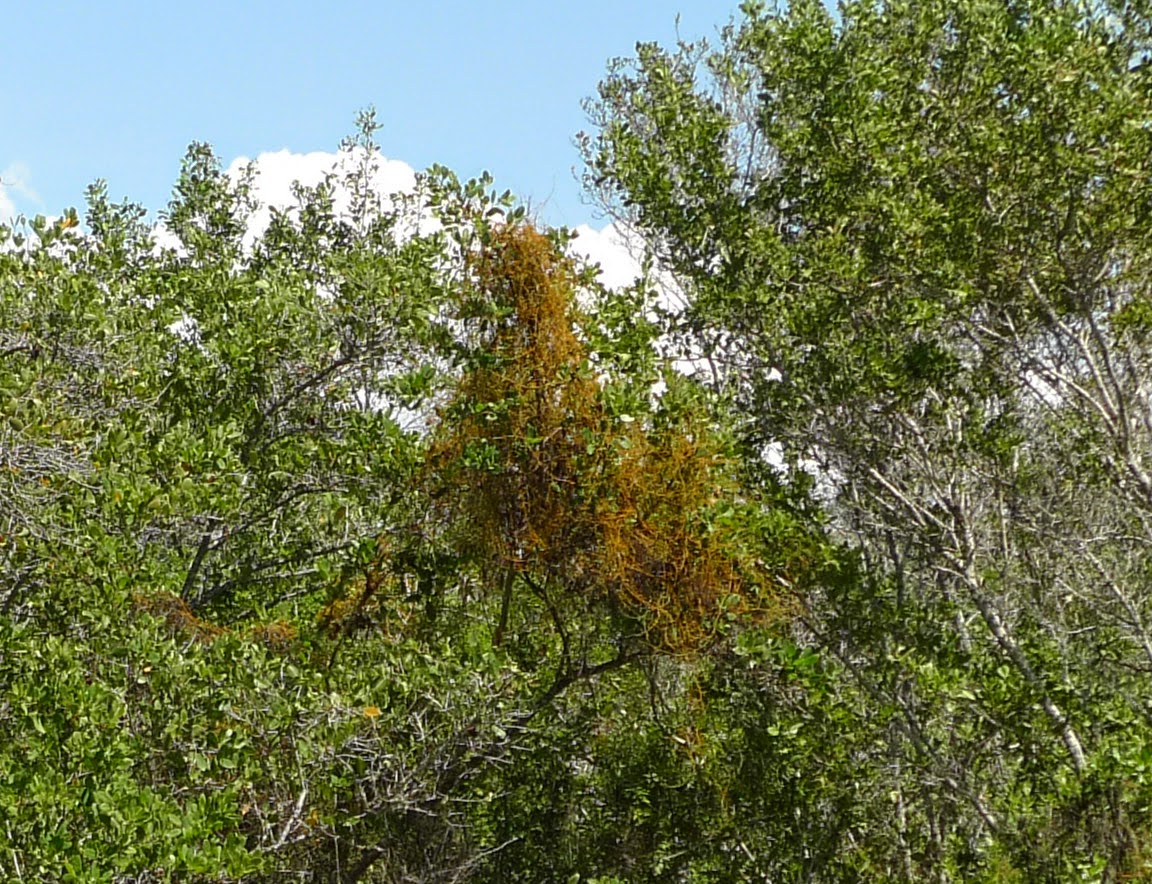 |
Dodder vine (brownish-orange above) is a parasitic native. It steals water from its host tree,
as well as exchanging DNA with it. |
 |
| West Coast sunflowers are native plants with yellow blooms. |
 |
| Ospreys built a nest in a tree burned by a lightning-strike fire 18 years ago. |
While slash pines can
survive losing the understory in a fire, once the canopy is burned, they
die. Other creatures, like the ospreys,
are happy to move in to the remains of the trees.
Fire at Honeymoon is managed in 5-year cycles. Prescribed fires are only lit during specific
conditions, such as
- High humidity
- E/SE winds (blowing away from the mainland)
- At 10/10:30 am or so, when the dew point drops
and before the sea breeze comes in
Trails double as fire breaks. Fire is a necessary part of the ecosystem. For instance, red cedar needs fire for their
cones to open and release their seeds so they can propagate.
Hercules' Club is a native plant with aromatic leaves when
crushed.
 |
| Hercules' Club (Zanthoxylum clava-herculis) |
 |
| Blurry pic: leaves of 3, let it be (poison ivy). |
Gopher tortoises create burrows 30 feet deep. They can also move surprisingly fast when a crowd of people arrive on the trail.
Brazilian Pepper, also known as Florida Holly, is a nonnative
invasive. It is controlled by pulling it
up by the root, or strangling it with an herbicide around the base. Cutting it just means it will sprout more
stems (like the Hydra of Greek myth).
 |
| Brazilian Pepper (Schinus herebinthifolius) |
Rosary Pea, an invasive exotic, has red, decorative berries
that are sometimes used in jewelry and are also extremely toxic if eaten,
particularly if they are crushed, at that allows more of the poison into the
system.
 |
| Rosary pea |
Cribbed from the helpful sign on the trail: "An invasive-exotic plant species is an introduced species
that has been shown to displace the native vegetation by out-competing native
species. Without the limiting factors
that normally keep invasive plants under control in their native homes, they
overwhelm and displace existing native vegetation to form dense, single species
stand that dominate and alter the original natural community."
On Honeymoon Island, non-native is described as anything that arrived before 1500 AD or so. Human and animal activity help disperse seeds far from their native homes. Cogan grass, for instance, another invasive in the area, likely arrived as packaging material on shipping crates from Asia. Birds also do their part transporting seed in their digestive tracts.


