Monday, September 1, 2014

Osprey Trail, Honeymoon Island State Park

Our first field trip, to the Osprey Trail on Honeymoon Island, began with the welcome news that we would not be removing invasive Rosary Pea.  At 94 degrees or so, with little wind and 20% cloud cover, it was deemed too darn hot by Dan Larremore, the environmental special of the Island who met our group there.    

Instead, Mr. Larremore gave us a tour of the Osprey Trail, pointing out plants and animals, with a particular emphasis on invasive exotic plants. 

While waiting for our group to arrive, gathered under the shade of a large tree with a female osprey (females have a spotted “necklace”) he gave a brief history of the island. Honeymoon Island and neighboring Caladesi Island used to be a single barrier island named Hog Island, but the No Name hurricane of 1921 blew a hole through the middle of the island, now known as Hurricane Pass.  Two families lived on the island at the time; one family lost to children during the storm, and moved off the island afterwards. 

In the 1940s, thatched huts were built on the island, and marketed as free honeymoon trips, which succeeded in changing the name of the island to Honeymoon.  Vacationers from up north were likely awed by the palm trees and gorgeous coastline, and likely less enthused by the thatched huts, which probably had a cockroach problem, given the insects fondness for palm fronds. 

In the 1960s, the area was slated for development, but that project collapsed, and instead, it became a state park.

The Osprey Trail is a slash pine flatland with mangrove ecotones.  Soil is sandy. 

The first invasive exotic plant we discussed was Lantana camara.  Originally from the West Indies, Lantana creates a dense understory difficult for native plants to penetrate.  Invasive nonnative lantana has a skunky smell, whereas native lantana smells more like Juicy Fruit. 

Lantana camara

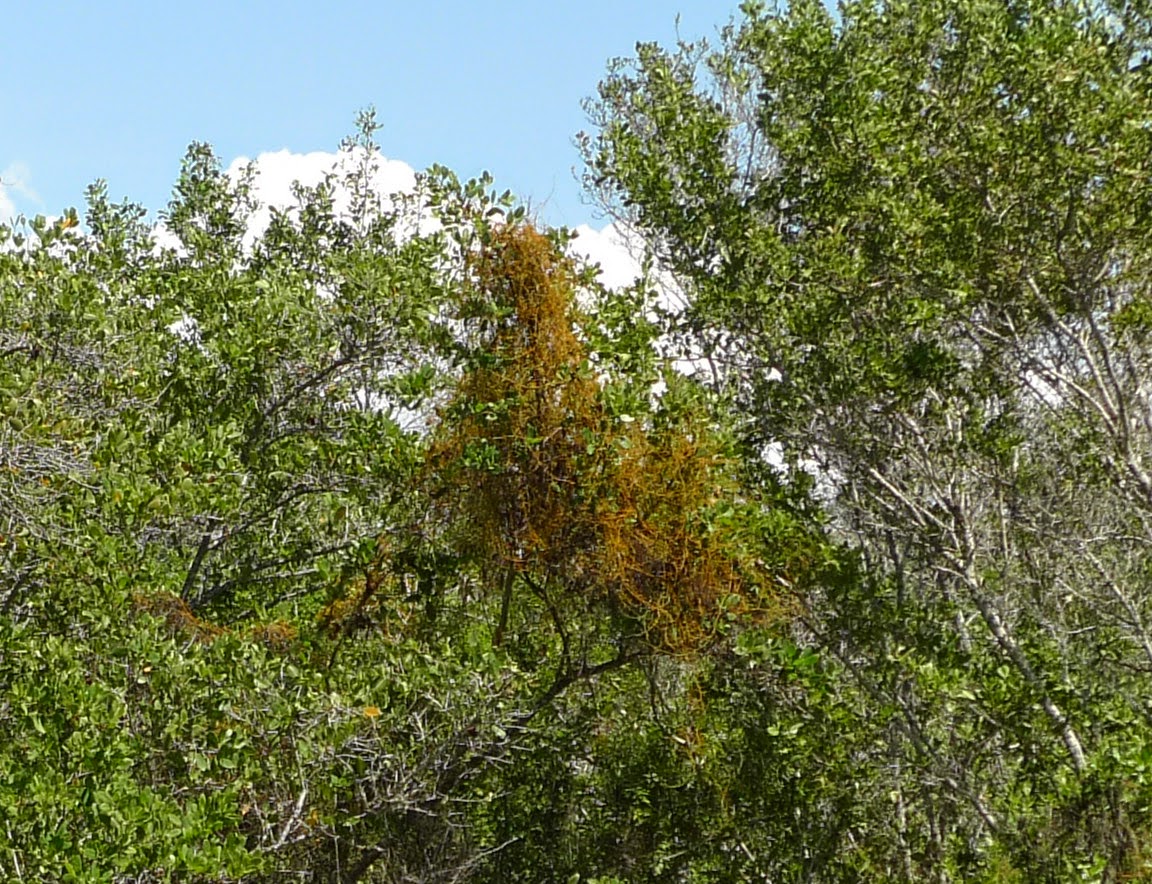
Dodder vine (brownish-orange above) is a parasitic native. It steals water from its host tree,
as well as exchanging DNA with it.

West Coast sunflowers are native plants with yellow blooms.  
Ospreys built a nest in a tree burned by a lightning-strike fire 18 years ago.
While slash pines can survive losing the understory in a fire, once the canopy is burned, they die.  Other creatures, like the ospreys, are happy to move in to the remains of the trees. 

Fire at Honeymoon is managed in 5-year cycles.  Prescribed fires are only lit during specific conditions, such as
  •  High humidity
  •  E/SE winds (blowing away from the mainland)
  •  At 10/10:30 am or so, when the dew point drops and before the sea breeze comes in

Trails double as fire breaks. Fire is a necessary part of the ecosystem.  For instance, red cedar needs fire for their cones to open and release their seeds so they can propagate. 

Hercules' Club is a native plant with aromatic leaves when crushed. 
Hercules' Club (Zanthoxylum clava-herculis)

Blurry pic: leaves of 3, let it be (poison ivy).
Gopher tortoises create burrows 30 feet deep. They can also move surprisingly fast when a crowd of people arrive on the trail. 


Brazilian Pepper, also known as Florida Holly, is a nonnative invasive.  It is controlled by pulling it up by the root, or strangling it with an herbicide around the base.  Cutting it just means it will sprout more stems (like the Hydra of Greek myth). 

Brazilian Pepper (Schinus herebinthifolius)
Rosary Pea, an invasive exotic, has red, decorative berries that are sometimes used in jewelry and are also extremely toxic if eaten, particularly if they are crushed, at that allows more of the poison into the system. 

Rosary pea 

Cribbed from the helpful sign on the trail: "An invasive-exotic plant species is an introduced species that has been shown to displace the native vegetation by out-competing native species. Without the limiting factors that normally keep invasive plants under control in their native homes, they overwhelm and displace existing native vegetation to form dense, single species stand that dominate and alter the original natural community." 

On Honeymoon Island, non-native is described as anything that arrived before 1500 AD or so.  Human and animal activity help disperse seeds far from their native homes.  Cogan grass, for instance, another invasive in the area, likely arrived as packaging material on shipping crates from Asia.  Birds also do their part transporting seed in their digestive tracts.  


Thursday, August 28, 2014

What a Honeymoon - Types of Species

8/28/14 at 2:00 PM
Location:      Osprey Trail on Honeymoon Island State Park
Conditions:  92 degrees Fahrenheit; winds <5mph
                     Mostly sunny with 20% cloud cover

Effects of fire in a tall underbrush due to lightning strike on slash pine (Pinus elliottii).
Chiococca alba - Common snowberry
     Today, Dan Laramore spoke with the class about the differences between native, endemic, and invasive species to Florida.  He walked us through a natural, managed area where all three could be seen.  An invasive species is one that was brought to Florida by travelers in the 1500s which competes with and replaces native species.  Some examples seen on this trail include the rosary pea, Brazilian pepper, cogongrass, and the balsam pear.  A native species is one that was in Florida without human intervention.  Some examples of native species seen include cabbage palm, poison ivy, slash pine (above), common snowberry (above), and the gopher tortoise.  An endemic species is one that is only found in Florida.  One such endemic species is the dune sunflower.

Friday, July 18, 2014


Wall Springs Park; Photo by Youlain F'2012
Welcome to Field Biology of Florida! 
In this course we will explore the natural areas of Florida and the flora, fauna, and physical characteristics that make them so unique. 

Friday, December 13, 2013


Chelsea Bartley

Extra Credit Assignment

Dec 15, 2013


          My favorite field trip was the Clearwater Marine Aquarium. I learned a lot on this field trip. I learned a lot on this one, mostly about the sea turtles. I talked with a woman there who worked very closely with them and I learned about the different types and how they were endangered. After talking to her I even have the desire to volunteer there in the near future. I had been there before, but it was nice to go in depth about the animals instead of just looking at them. Aside from the animals I also learned a lot about our environment and how it effects the animals on a daily basis. 

Saturday, December 7, 2013

Brooker Creek adventure!


I think my favorite place that we visited this semester was Brooker Creek. I was shocked and delighted by the amount of wildlife we encountered. If there was ever a field trip where I thought I was on the Magic School Bus it would be this one for sure! Brooker Creek is mostly forested wetlands and pine flatwoods. The park is kind of off the beaten path but worth the drive for a truly "Florida"
experience. The park is surrounded by urban development but it has in no way disturbed its charm and beauty. Once used for citrus and cattle the land is now home to an all star line up of Florida wildlife. While we were there we were lucky enough to see, not one, not two but three snakes, and an alligator! The first snake was a harmless Coluber constrictor priapus, commonly known as the southern black racer and he was peacefully chilling on the banks of Brooker Creek. The other one however, was coiled and looking to kill... and being the fierce Agkistrodon piscivorus (commonly known as a cottonmouth) I'd say he had a pretty good chance at it. Beautiful, fantastic creature with impeccably camouflaged skin; I thoroughly enjoyed getting a glimpse of him in his natural habitat (last bit in an Australian accent:). But by far the best part of the whole trip was when we all tried to push on through the one time trail and now part time swamp near the end of the trek. Hats off to the few class mates who boldly walked ahead and were covered in good ol' Florida muck! All I remember is Dr. G shouting " Just remember everyone you're going to look back on this adventure and smile!". She was so right! I loved this class and thoroughly enjoyed every informative second of Dr. G's lectures and fabulous field trips...but this one was my favorite!

Monday, December 2, 2013

My Favorite Field Trip was to Booker Creek Preserve

Booker Creek Preserve

This field trip was my favorite because I enjoyed the adventure and seeing all the different communities. There were Oak Hammocks, Pine Flatwoods, and Cypress Domes. This in my opinion was the most adventurous field trip. We got off the beating path and took one that was flooded out. 

This environment can adapt to flooding with tree roots that are above the water level. There were many ferns that do well in this shady environment. I observed several species like a pygmy rattlesnake, and a cottonmouth both poisonous. I also seen a good size Alligator basking in the sun on the bank. 

I really enjoyed this class and I know so much more about Florida and I hope to continue to learn more in my future endeavors. 

Thank you

Alaina DiPaolo

Friday, November 29, 2013


Fred Howard Park


      My favorite field trip was Fred Howard Park. This underwater community was very fun to go look around. Observing all the animals that live close to the shore was very interesting. I saw a variety of different animals including two humongous horseshoe crabs. I even saw some actual sponges. Another dominant species was the pinfish, which seems to be a dominant species in any form of water in Florida lol. There even a couple of stingrays. For the field biology has been one of my favorite classes. I'm glad I took it